Alien Nation: Common Sense About America's Immigration Disaster by Peter Brimelow
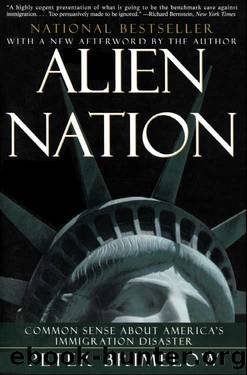
Author:Peter Brimelow [Brimelow, Peter]
Language: eng
Format: epub
Published: 2013-02-18T00:00:00+00:00
7 IMMIGRATION HAS CONSEQUENCES: ECONOMICS
Now looking ahead to the twenty-first centuryâthis is my social work coming out in me nowâin the twenty-first century, and that's not far off, [minority] racial and ethnic groups in the U. S. will outnumber whites for the first time. The browning of America will alter everything in society from politics and education to industry, values and culture. . . . And as I talk with the faculty and the staff here at Ripon they're aware of this and they're helping prepare for this.âADA DEER, lecturer, School of Social Work and Indian Studies, University of Wisconsin at Madison, and former chair of the Menominee Indian tribe, Clinton administration nominee for Assistant Secretary of Indian Affairs, in her commencement address to Ripon College, May 15, 1993
Ripon, Wisconsin, is the site of the Republican party's founding in 1854 and heart of an area that is currently 98 percent white. Nevertheless, Ada Deer, cited above, was apparently able to talk its credulous college teachers into "helping prepare" for something that may never happen.
(Erâwhat, exactly, does Ms. Deer mean by "prepare"? Well, the Associated Press reported her adding that "everyone in the hemisphere should know Spanish.")
As we have seen, however, there is no certainty at all that minorities will "outnumber whites" in the twenty-first century. That can occur only in one extraordinary circumstance: if massive Third World immigration is allowed to continue at its current unprecedented rate. Ms. Deer is right about one thing, however. The ethnic shift brought about by such immigration would indeed inevitably "alter everything in society."
Multicultural enthusiasts happily proclaim this vital point at the very time that immigration enthusiasts are trying to play it down. In the symposium in response to my National Review cover story, Julian Simon even proposed "a general theory"â
... explaining why immigrants have had so little noticeable effect on American life patterns. The pattern of civic life remains what it was before a wave of immigration, unless the immigrants are greater in numbers or riches than the prior residents. The chances that any immigrants into the U.S. will meet these conditions is nil.1 As we have seen, of course, if immigration is allowed to continue, the post-1965 immigrants and their descendants are likely to outnumber pre-1965 Americans in large areas of the United States. And it is quite possible that some groups, perhaps the Cubans of Miami and the Asians of California, will be wealthierâjust like the Jews of New York have become.2
But the "general theory" is, well, distinctly divorced from reality anyway. Nearly half a century ago, the philosopher Richard Weaver published a book the title of which convinced many Americans, at least in the conservative movement: Ideas Have Consequences. Similarly, if they consider the evidence fairly, they cannot evade a further truth: Immigration Has Consequencesâespecially in their own, much-blessed country.
IMMIGRATION AND ECONOMICS
"The business of America is business," President Calvin Coolidge once famously remarked. Many of his countrymen still wince at his crassness. But, curiously, when asked about immigration, they very quickly start talking about economics.
Download
This site does not store any files on its server. We only index and link to content provided by other sites. Please contact the content providers to delete copyright contents if any and email us, we'll remove relevant links or contents immediately.
| Anthropology | Archaeology |
| Philosophy | Politics & Government |
| Social Sciences | Sociology |
| Women's Studies |
The Secret History by Donna Tartt(19294)
The Social Justice Warrior Handbook by Lisa De Pasquale(12224)
Thirteen Reasons Why by Jay Asher(8995)
This Is How You Lose Her by Junot Diaz(6955)
Weapons of Math Destruction by Cathy O'Neil(6362)
Zero to One by Peter Thiel(5864)
Beartown by Fredrik Backman(5839)
The Myth of the Strong Leader by Archie Brown(5552)
The Fire Next Time by James Baldwin(5503)
How Democracies Die by Steven Levitsky & Daniel Ziblatt(5271)
Promise Me, Dad by Joe Biden(5189)
Stone's Rules by Roger Stone(5130)
A Higher Loyalty: Truth, Lies, and Leadership by James Comey(5017)
100 Deadly Skills by Clint Emerson(4972)
Rise and Kill First by Ronen Bergman(4836)
Secrecy World by Jake Bernstein(4798)
The David Icke Guide to the Global Conspiracy (and how to end it) by David Icke(4771)
The Farm by Tom Rob Smith(4549)
The Doomsday Machine by Daniel Ellsberg(4542)
